
Our research and development team aims to tackle the industry’s most pressing challenges by exploring alternative ways of building and living. Through interdisciplinary collaboration, we treat the environmental and social challenges as opportunities for innovation and improvement.

Hargrave Hall
At the centre of our research is the intersection between Nature and Technology, allowing us to find new design solutions through sustainability and digital innovation. We believe in designing the logistics of a building system that can adapt and evolve as needs arise.
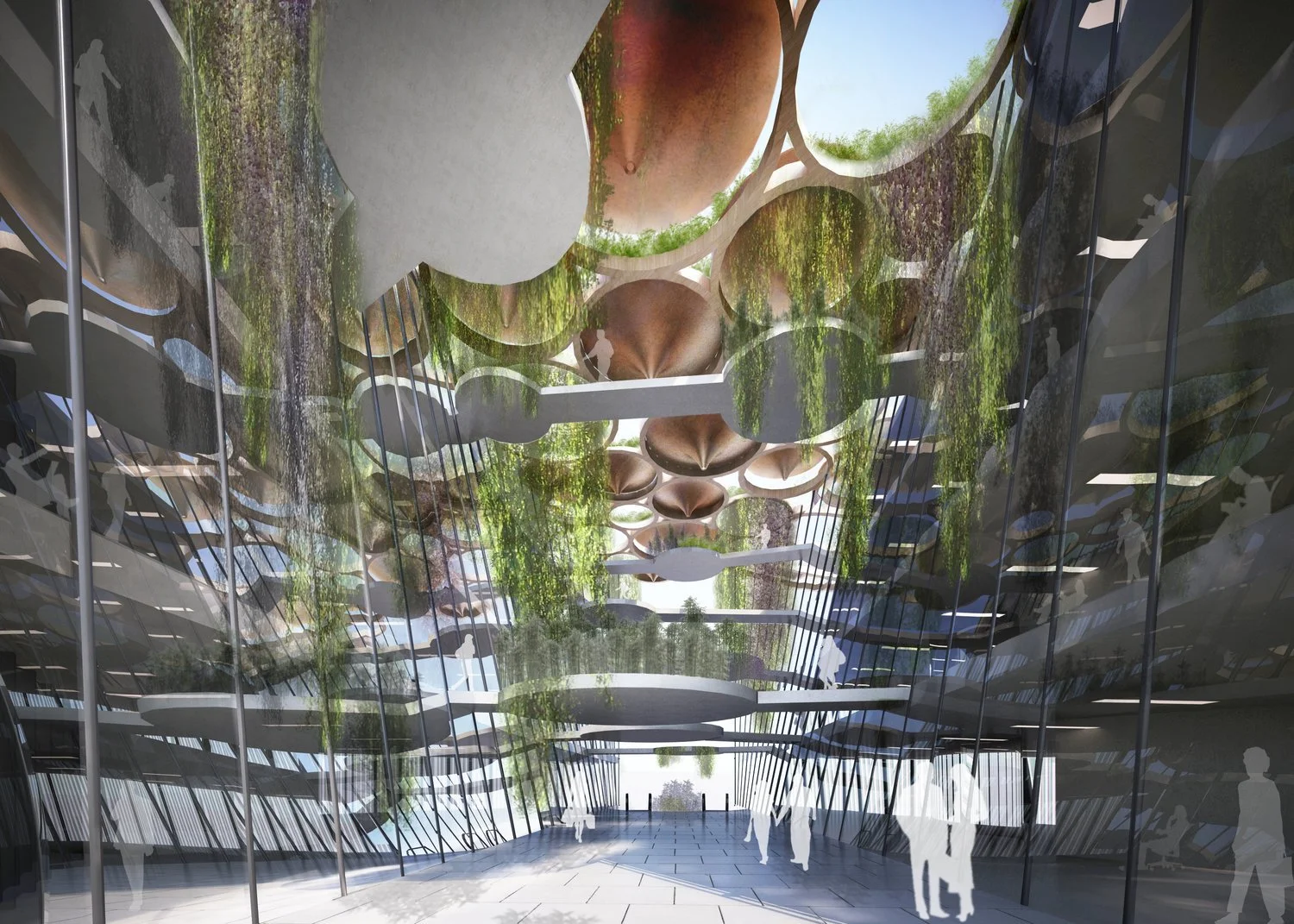
Future Cities
Britain today has a 4.3 million homes that are missing from the national housing market
To rethink the way we live we must rethink the way we build .

Saint Gobain customizable home
The housing sector faces two massive challenges; The first is addressing the affordable housing shortage and the second are the ambitious zero carbon goals set by the government to combat climate change.
A conservative construction industry is proving slow to adapt to face these goals and a new model for design is needed to rethink the relationship between the home and its end user. We need to rethink what is standardised and what is customised. To treat design less as a formal creation of a static object and more as agile product with distinct parts able to reconfigure and adapt to accommodate changing needs. A Design process is therefore required that moves from static representation of a formal idea to a design of a system that can be organized and controlled using digital tools.

Kew Treehouse Competition
We use modular offsite construction combined with algorithmic tools to find new ways to maximise potential customization of repeatable standardised parts.
Kajima - Adelaide Rd.
From the power of computation, simple base parts can be repeated and articulated in such a way that they can create a richness in forms and possibilities.
Modular Components can be disassembled, reconfigured, and reused in a LEGO-like approach. This process reduces the carbon footprint for building modules where parts can potentially be reused.

Modomo - Modular meanwhile housing

EW + SW Solar Exposure Tool
40% of global CO2 emissions are attributed to the built environment
Our commitment to finding innovative ways to reduce carbon emissions and drive sustainable behaviours has earned us the highly coveted title of Architectural Practice of the Year in 2012. This achievement prompted the creation of our Research and Development group, dedicated to exploring the key challenges we face in the industry.

Swan Housing System , Laindon
Linking to offsite fabrication methods and using a kit of parts approach to modularity, we aim to use technology available in digital design tools to create environments that harness the power of the virtual world to create innovative modes of communication and collaboration. This process engages with many different stakeholders to input in finding a new relationship between customisation and standardisation

Amodular System Propotype
A recent study found that using offsite construction could cut carbon emissions by as much as 45% compared with traditional building methods.

Davidson Prize- Modular Solutions for Temporary accomodation
Our collaboration with universities is a dynamic exchange of ideas, where the academic rigor meets the practical challenges of real-world architectural projects. By engaging with academics and students, we foster an environment that encourages exploration, experimentation, and the integration of cutting-edge research into our design processes.

Light Absorbing Algae
Sustainability is integral to our architectural approach, and partnering with universities enables us to explore eco-friendly design solutions. We harness the expertise of researchers and students to delve into materials, construction techniques, and energy-efficient systems aligned with our commitment to environmentally responsible structures.

Algae Facade - Brunel University